What Is DEXIA? A Method for Teaching Better Classes Without Becoming Less Human
Can you teach better with artificial intelligence without letting the technology eat your class alive? We asked ourselves that question at Cerebrote, and the answer became a diploma program, a method, and — now — this series of posts we’re giving away, complete and online, to any teacher in the world who wants to read it.
Let me tell you how we got here.
A diploma program that became a community
DEXIA stands for Diseño de Experiencias de Aprendizaje con Inteligencia Artificial — the Design of Learning Experiences with Artificial Intelligence and Augmented Humanity. It’s the teacher training program of Cerebrote, an international community of teachers based in Bucaramanga, Colombia. (Quick vocabulary note: around here we say profe — it’s how Latin American students affectionately call their teachers, and it’s the best job title we know.)
In its 2026 cohort, DEXIA brought together nearly four thousand profes from twenty-two countries, every Saturday morning, for sixteen weeks and 192 certified hours.
Four thousand teachers don’t give up their Saturday mornings for a tech fad. They show up because of a question that keeps all of us awake: how do we teach humans in an age of ubiquitous artificial intelligence — without losing our humanity in the process?
The idea that holds everything together: the DEXIA Triangle
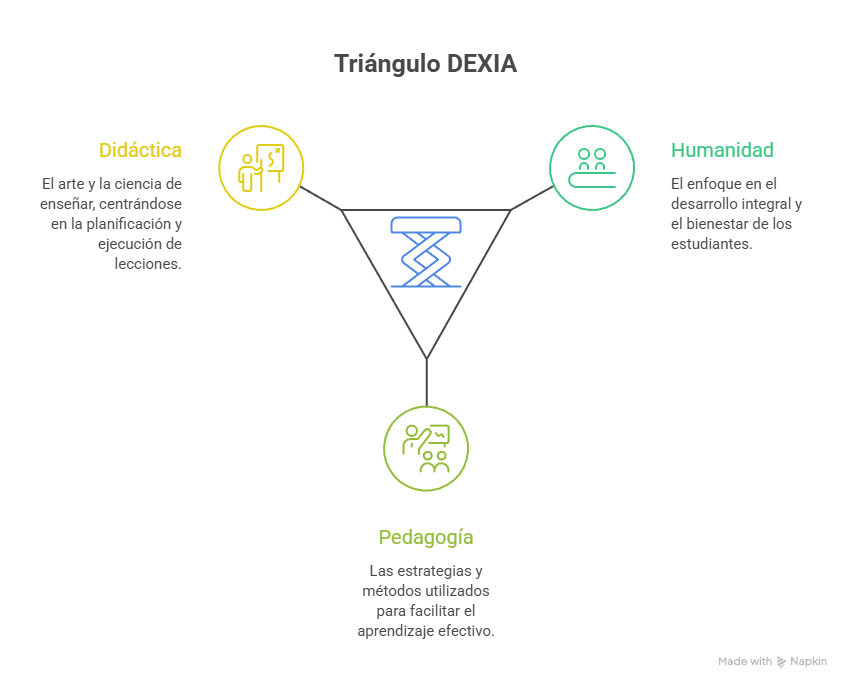
At Cerebrote we don’t believe in magic recipes or in tools that promise to “revolutionize education” every other week. We believe in a triangle. Three dimensions you cannot pull apart:
- Humanity: who we teach. A student whose brain has genuinely changed — the science is real — from growing up among screens, and a teacher who is also human, gets tired, and deserves well-being.
- Pedagogy: what we teach for, and how. The methodologies that actually work, from Teaching for Understanding to Universal Design for Learning.
- Didactics: what we teach with. There, and only there, does artificial intelligence come in.
Notice the order? It’s no accident. The human comes first, the method second, the tool last.
The trick that changes everything: AI behind the teacher
If you take one single idea from this entire blog, make it this one: artificial intelligence belongs behind the teacher, not in front of the student.
What does that mean? AI doesn’t walk into the classroom to replace the lesson or babysit teenagers with another screen. It sits at the teacher’s desk: it helps you plan, create resources, design games, analyze assessments, and personalize your teaching to your school’s actual educational project. The student gets a more human class, not one more screen. The teacher gets time and energy back. That’s what we mean by augmented humanity.
Sounds simple. Doing it well takes 192 hours. Hence this series.
The map: the eight DEXIA modules
Each module of the program became a post in this series, with its solutions published in full: complete prompts, numbered steps, and what we learned along the way — including what didn’t work, because we don’t sell smoke around here. Here’s the map:
- Your student isn’t lazy: their brain adapted. The neurocognitive changes of today’s students and the core human skills of the 21st century. Facilitator: Luis Fernando Botero Mendoza, M.Ed. (Colombia).
- Methodologies for teaching humans, with AI as co-pilot. Teaching for Understanding and active methodologies, with AI as co-designer. Facilitator: Luis Fernando Botero Mendoza, M.Ed. (Colombia).
- The AI tools every teacher should know. The essential kit — with ethical judgment and zero fanboying. Facilitator: Prof. Gustavo Coronel (Argentina).
- Videos, images and infographics that actually teach. Audiovisual resources made with AI, grounded in visual communication principles. Facilitator: Prof. Hugo Damián Arcuri (Argentina).
- An escape room without leaving the classroom. Narrative, gamification and immersive experiences — because what moves us is what we learn. Facilitator: Prof. Linalyn Dorta (Venezuela/Peru).
- Lesson planning that doesn’t sacrifice the teacher. The DEXIA Planning Matrix: teacher well-being, diversity and authentic assessment. Facilitator: Lucy Garnica, Ph.D. (Colombia).
- AI that respects your school’s identity. Real institutional personalization: AI that plans according to your school’s educational project, not a generic one. Facilitator: Prof. Hugo Andrés Belalcázar Cerón (Colombia).
- Assess to understand, not to punish. Levels of learning, instruments that actually work, and assessment as a pedagogical resource. Facilitator: Luis Fernando Botero Mendoza, M.Ed. (Colombia).
(Each title will link to its post as they are published.)
And why are we giving all of this away?
Because at Cerebrote we believe knowledge is meant to be shared, not hoarded. This blog exists so that a teacher in rural Guatemala, in the Colombian Guajira or — why not — in Ohio or Nairobi can find, on a Sunday night, the concrete solution they need for Monday’s class. No paywall, no sign-up form, no fine print.
And because we hold a conviction that doubles as our motto: Latin America, world power of humanity. While the world debates whether AI will replace teachers, we’re busy proving something else: that today’s technology demands more human teachers, not fewer. And humanity happens to be something this continent knows a great deal about.
Alright — that’s the map. Pick the module you need most, or start from the first one. We’ll be here.
All living resources for this series live at cerebrote.com/dexia/. The tool brands mentioned across the series (ChatGPT, Gemini*, NotebookLM*, Canva* and others) are registered trademarks of their respective owners; Cerebrote has no commercial ties with any of them.*